
Would you love to pray the rosary but aren’t quite sure where to begin? Don’t worry: it is one of the simplest prayers there is. This guide walks you through it step by step: what each bead is for, which prayers to say, which mysteries to meditate on each day, and how to make room for the rosary in a life that is already full.
What is the rosary?
The rosary is both an object and a prayer. The object is that string of beads ending in a cross, which lets you count your prayers without having to think about it. The prayer is a series of Hail Marys said peacefully while meditating on the great moments in the life of Jesus, which we call the mysteries. Saint John Paul II summed it up in a single sentence: to recite the Rosary is “nothing other than to contemplate with Mary the face of Christ”.
In French, the rosary is called a chapelet, from the old word “chapel”, a crown of flowers once offered as a mark of honour (the English “chaplet” shares the same root): praying the rosary is a little like weaving a crown of roses for Mary. To discover how this prayer has come down through the centuries, read the history of the rosary.
Rosary, full Rosary, decade rosary: what’s the difference?
- The rosary (or chaplet) has five decades of beads. It is prayed while meditating on one set of five mysteries.
- The full Rosary, from the Latin rosarium, “rose garden”, strictly speaking refers to all twenty mysteries, in other words four rosaries. In everyday language, though, “rosary” simply means the five-decade prayer beads, and that is perfectly fine.
- The decade rosary has just one decade, with its cross. Discreet, it slips into a pocket or hangs from a bag. By going round it five times, you can even pray a whole rosary.
How to pray the rosary, step by step
A rosary is made up of a cross, a short strand of five beads, then a loop of five decades joined by a medal. The single beads, often slightly larger or simply set apart by a length of chain, are the Our Father beads. Take the rosary by the cross and let yourself be guided:
- On the cross: make the Sign of the Cross, saying “In the name of the Father, and of the Son, and of the Holy Spirit. Amen”, then say the Apostles’ Creed.
- On the first large bead: one Our Father.
- On the three small beads: three Hail Marys, asking to grow in faith, hope and charity.
- Straight afterwards: one Glory Be.
- On the next large bead: announce the first mystery, for example “The first Joyful Mystery: the Annunciation”, take a moment to picture the scene, then say one Our Father.
- On the ten small beads: ten Hail Marys, keeping this mystery in your heart.
- To close the decade: one Glory Be, then, if you wish, the Fatima Prayer, “O my Jesus…”.
- For the next four decades: the same pattern, announcing the next mystery each time on the large bead.
- To finish: back at the medal, pray the Hail, Holy Queen, then make the Sign of the Cross once more.
How long does it take? Allow about twenty minutes for a whole rosary, and barely five minutes for a single decade. Aloud or in silence, at home or with others, it is always the same prayer.
The four sets of mysteries
The twenty mysteries of the Rosary form four sets of five, which tradition spreads across the week. This rhythm is a guide, not an obligation: Saint John Paul II, who added the Luminous Mysteries in 2002, left everyone free to adapt it.
The Joyful Mysteries: Monday and Saturday
- The Annunciation: the angel Gabriel announces to Mary that she will be the mother of the Saviour.
- The Visitation: Mary goes to visit her cousin Elizabeth.
- The Nativity: Jesus is born in Bethlehem.
- The Presentation in the Temple: Mary and Joseph present the child Jesus to the Lord.
- The Finding of Jesus in the Temple: his parents find him among the teachers of the Law.
The Luminous Mysteries: Thursday
- The Baptism of Jesus: in the Jordan, the Father declares him his beloved Son.
- The Wedding at Cana: at Mary’s request, Jesus turns water into wine.
- The Proclamation of the Kingdom: Jesus proclaims the Good News and calls people to conversion.
- The Transfiguration: Jesus appears in his glory before Peter, James and John.
- The Institution of the Eucharist: at the Last Supper, Jesus gives his Body and Blood under the signs of bread and wine.
The Sorrowful Mysteries: Tuesday and Friday
- The Agony in the Garden: on the Mount of Olives, Jesus prays and surrenders himself to the Father’s will.
- The Scourging at the Pillar: Jesus is scourged on Pilate’s orders.
- The Crowning with Thorns: the soldiers mock him and crown him with thorns.
- The Carrying of the Cross: Jesus walks to Calvary, helped by Simon of Cyrene.
- The Crucifixion: Jesus dies on the cross, with Mary standing at its foot.
The Glorious Mysteries: Wednesday and Sunday
- The Resurrection: on Easter morning, the tomb is empty; Jesus is alive.
- The Ascension: Jesus ascends into heaven, to the Father.
- The Descent of the Holy Spirit: at Pentecost, the Holy Spirit comes down upon the apostles gathered with Mary.
- The Assumption: at the end of her earthly life, Mary is taken up into heaven, body and soul (celebrated on 15 August).
- The Coronation of Mary: the Virgin Mary is crowned Queen of heaven and earth.
The prayers of the rosary
Here are the prayers in full, in their traditional English wording. There’s no need to know them by heart: the more you read them, the more familiar they will become.
The Apostles’ Creed
It sums up the faith of the Church; it is said only once, on the cross.
I believe in God, the Father Almighty, Creator of heaven and earth;
and in Jesus Christ, his only Son, our Lord, who was conceived by the Holy Spirit, born of the Virgin Mary, suffered under Pontius Pilate, was crucified, died and was buried; he descended into hell; on the third day he rose again from the dead; he ascended into heaven, and is seated at the right hand of God the Father Almighty; from there he will come to judge the living and the dead.
I believe in the Holy Spirit, the holy catholic Church, the communion of saints, the forgiveness of sins, the resurrection of the body, and life everlasting. Amen.
The Our Father
The prayer taught by Jesus himself, which he gave to his disciples when they asked him, “Lord, teach us to pray.”
Our Father, who art in heaven, hallowed be thy name; thy kingdom come; thy will be done on earth as it is in heaven. Give us this day our daily bread; and forgive us our trespasses, as we forgive those who trespass against us; and lead us not into temptation, but deliver us from evil. Amen.
The Hail Mary
It takes up the greetings of the angel Gabriel and of Elizabeth, then entrusts our whole life to Mary.
Hail Mary, full of grace, the Lord is with thee. Blessed art thou among women, and blessed is the fruit of thy womb, Jesus.
Holy Mary, Mother of God, pray for us sinners, now and at the hour of our death. Amen.
The Glory Be
A short song of praise to the Trinity, which closes each decade.
Glory be to the Father, and to the Son, and to the Holy Spirit, as it was in the beginning, is now, and ever shall be, world without end. Amen.
The Fatima Prayer
Taught by the Virgin Mary to the three little shepherd children of Fatima in 1917, it may be said, if you wish, after the Glory Be of each decade.
O my Jesus, forgive us our sins, save us from the fires of hell; lead all souls to heaven, especially those in most need of thy mercy.
This is the wording most widely used in English. In some parishes you will also hear “… especially those who have most need of thy mercy”, or simply “… especially those most in need”. It is the same prayer.
Hail, Holy Queen (Salve Regina)
This very ancient antiphon to the Virgin Mary, often sung in Latin, brings the rosary to a close.
Hail, holy Queen, Mother of mercy, our life, our sweetness and our hope. To thee do we cry, poor banished children of Eve; to thee do we send up our sighs, mourning and weeping in this valley of tears.
Turn then, most gracious advocate, thine eyes of mercy toward us; and after this our exile, show unto us the blessed fruit of thy womb, Jesus. O clement, O loving, O sweet Virgin Mary!
When you’re just starting out or short of time
The rosary is not a performance, and no one is asking you to pray the whole thing on day one. Here are a few ways to make room for it, without pressure or guilt:
- One decade a day. One Our Father, ten Hail Marys, one Glory Be: barely a few minutes, and already a true prayer. That is the whole point of the decade rosary, which fits in a pocket.
- While walking. The rhythm of your steps naturally matches the rhythm of the prayer, whether on the way to work or out for a stroll.
- On public transport. A decade rosary tucked in your pocket, the beads slipping between your fingers: no one needs to know you are praying.
- No rosary to hand? Your ten fingers are enough to count a decade.
Distractions are part of the journey: when your mind wanders, simply come back to the prayer, without judging yourself. To keep your focus, you can add a short phrase recalling the mystery after the name “Jesus”, such as “Jesus, born in Bethlehem”. And if it helps to reassure you, Saint Thérèse of Lisieux herself confessed: “Try as I may to meditate on the mysteries of the Rosary, I cannot manage to fix my mind on them.” In the end she grieved over it less, trusting that the Virgin, her Mother, saw her good will and was content with it.
Choosing your rosary
The best rosary is the one you will want to pick up, day after day. A few pointers:
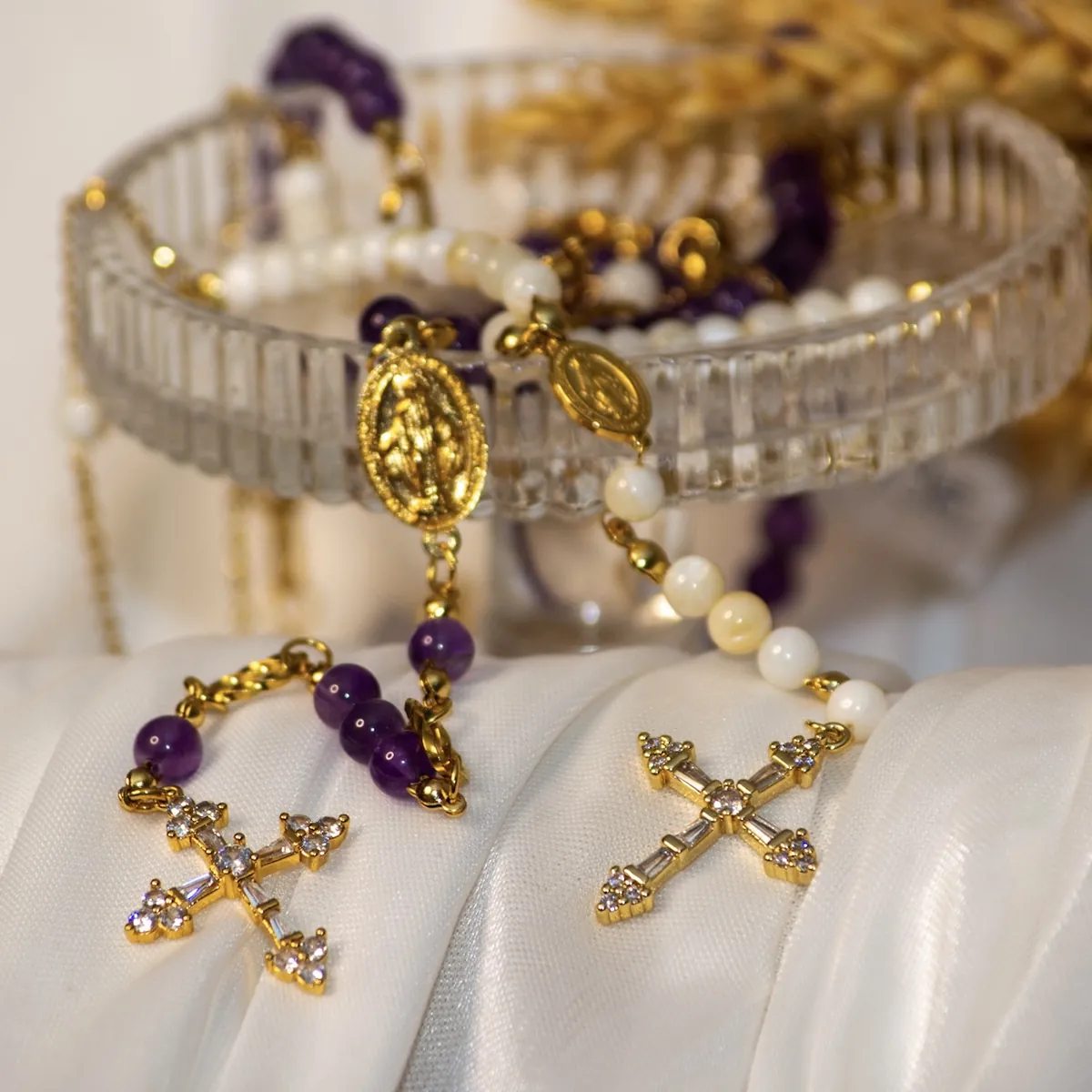
- The beads. Amethyst, lapis lazuli, agate, garnet, mother-of-pearl or cultured pearls: each material has its own colour, its own weight, its own softness under the fingers. Natural stones each have their own shades, so no two rosaries are ever quite the same.
- The size: 4 or 6 mm. 4 mm beads make a fine, delicate rosary that slips in anywhere. At 6 mm, it has more presence in the hand: you can really feel each bead under your fingers, which helps when praying with your eyes closed.
- Sturdiness. A rosary is handled every day: check that the links are properly closed and that the cross is firmly attached. The Atelier’s rosaries are assembled by hand in Provence, link by link.
- Rosary or decade rosary? The rosary accompanies your times of prayer at home; the decade rosary goes everywhere with you, hanging from a bag or slipped into a pocket.
To go further, read also How to choose a Christian rosary
Having your rosary blessed
A rosary doesn’t need to be blessed to be used for prayer: you can start today. But a blessing is a beautiful gesture, which entrusts the object to God and sets it apart for prayer.
Nothing could be simpler: ask a priest at the end of Mass, in the sacristy or at your parish office. He says a short prayer, makes the sign of the cross and sometimes sprinkles the rosary with holy water. It takes only a minute, and most priests are very happy to do it. Giving a rosary as a gift? Have it blessed before you give it.
Once blessed, the rosary becomes what the Church calls a “sacramental”: not a lucky charm, but a sign that invites us to prayer, to be treated with respect. If it breaks beyond repair, it isn’t thrown away with the rubbish: it can be buried, or you can ask your parish for advice.
Some of the Atelier’s rosaries are dipped in holy water from the Basilica of Notre-Dame de la Garde in Marseille, an option also offered for custom pieces. This symbolic gesture does not bless the rosary: for that, please ask a priest.
Caring for your rosary
Most of the Atelier’s rosaries and decade rosaries combine natural beads with a chain and cross in gold-plated brass. To keep them shining for a long time:
- Keep it dry. Gold-plated brass doesn’t like water: take your rosary off before showering, swimming or washing up.
- Keep it away from perfume. Let perfume, cream or hand sanitiser dry completely before picking it up.
- Store it in a pouch, apart from your other jewellery to avoid scratches and tangles, and away from damp.
- Wipe it with a soft, dry cloth, without any product.
- Handle the beads gently: mother-of-pearl and cultured pearls in particular are sensitive to knocks.
Your stainless steel jewellery, on the other hand, isn’t afraid of water: here are our care tips for stainless steel.
And if you dream of a rosary that reflects who you are, Floriane can create it for you: you choose the beads, their size, the cross and, if you wish, a small engraving. Design my custom rosary
